JOBNET Career Intelligence
Views on the Interview
Beyond Questions and Answers - Understanding the Purpose of an Interview
About This Article
A Different Perspective on Interviews
In this insightful article, Anil Mahajane presented a different perspective on interviews. Rather than viewing them as stressful question-and-answer sessions, he encouraged professionals to see interviews as opportunities to demonstrate competence, confidence, character and business value.
The article explored how preparation, communication, attitude and professional presence influence hiring decisions just as much as technical knowledge.
Original Publication
JOBNET - February 2004
Scanned pages from the original printed publication.
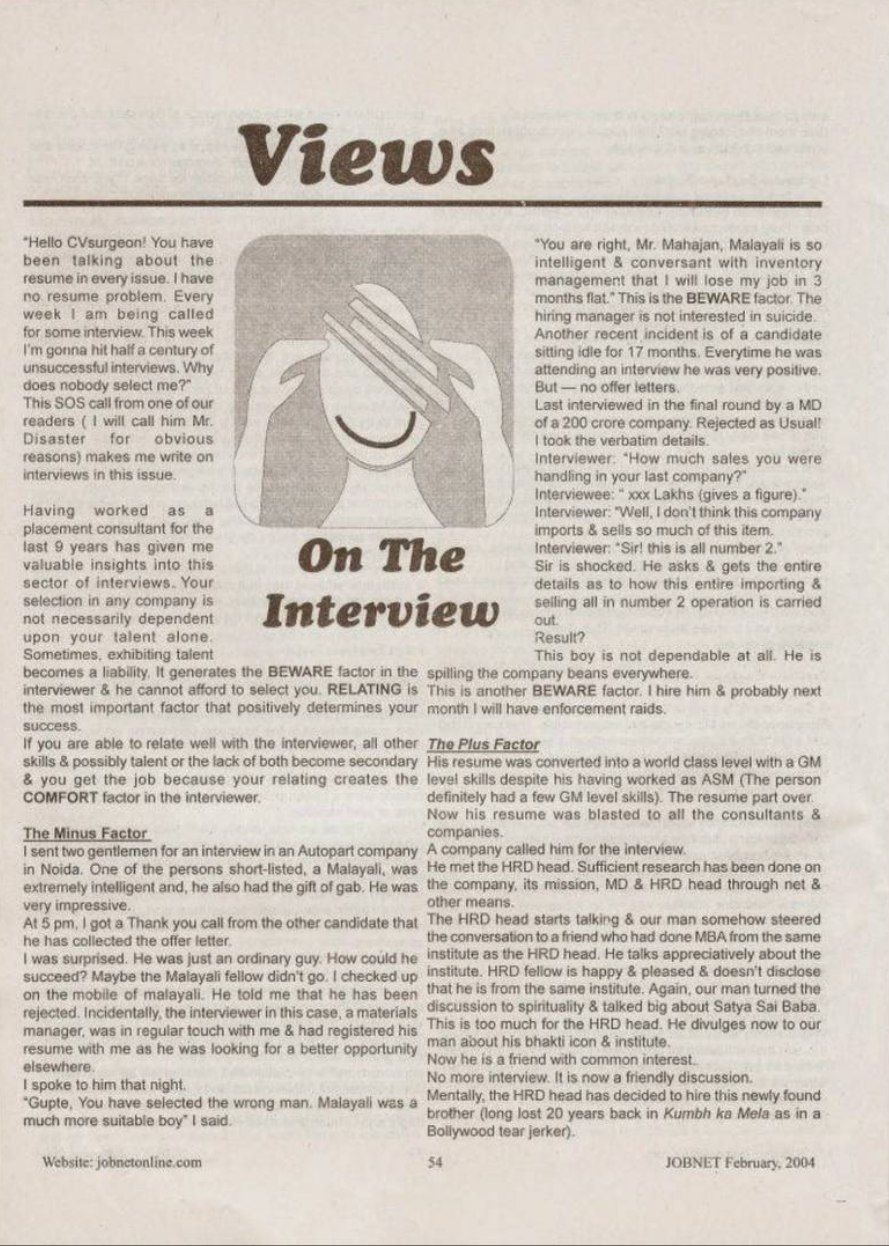
JOBNET February 2004 - Page 1
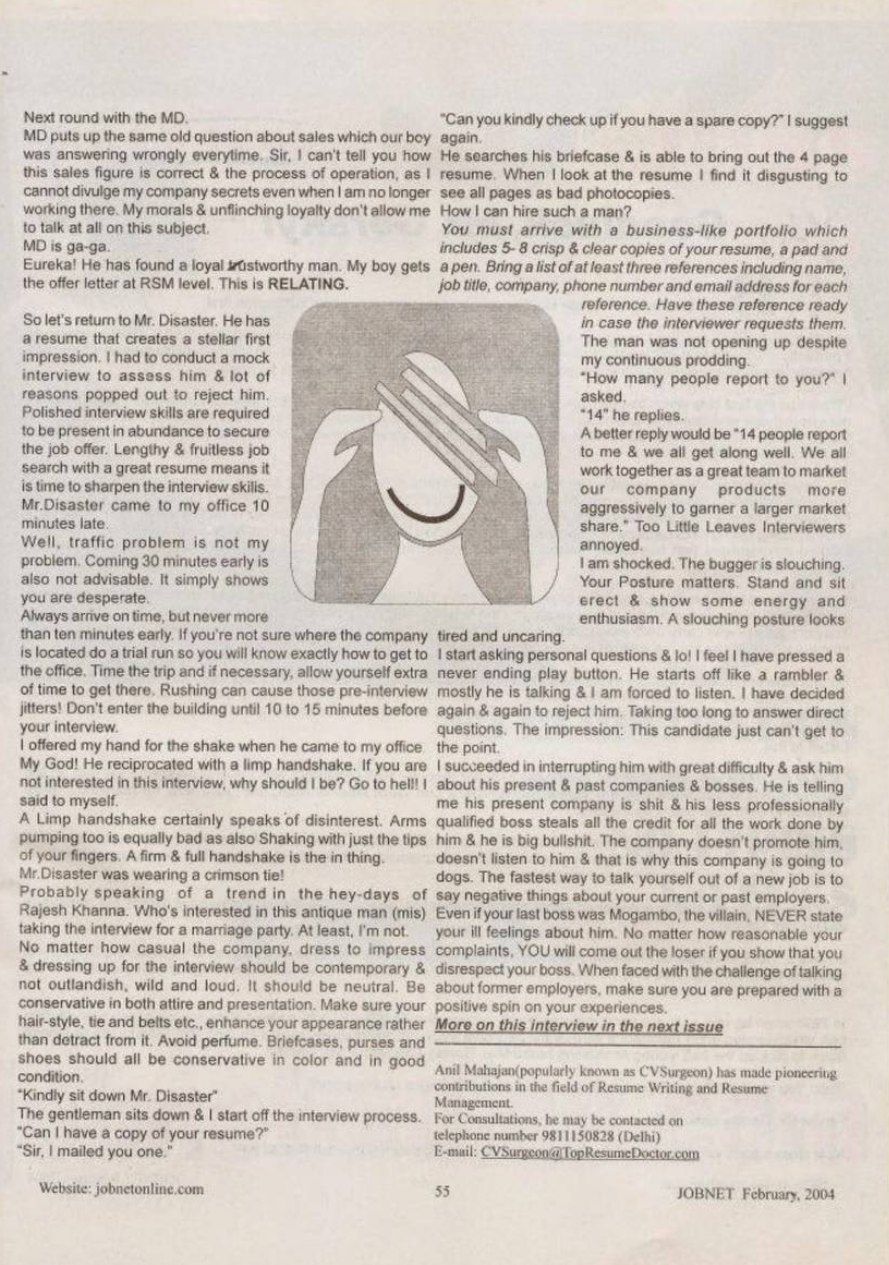
JOBNET February 2004 - Page 2
Article Transcript
Views on the Interview
Originally published in JOBNET - February 2004
"Hello CVsurgeon! You have been talking about the resume in every issue. I have no resume problem. Every week I am being called for some interview. This week I'm gonna hit half a century of unsuccessful interviews. Why does nobody select me?" This SOS call from one of our readers (I will call him Mr. Disaster for obvious reasons) makes me write on interviews in this issue.
Having worked as a placement consultant for the last 9 years has given me valuable insights into this sector of interviews. Your selection in any company is not necessarily dependent upon your talent alone. Sometimes, exhibiting talent becomes a liability.
The Negative
The BEWARE Factor
It generates the BEWARE factor in the interviewer - and he cannot afford to select you. Displaying excessive talent or exposing company secrets signals a threat rather than an asset.
The Positive
The RELATING Factor
RELATING is the most important factor that positively determines your success. If you are able to relate well with the interviewer, all other skills become secondary - you get the job because your relating creates the COMFORT factor.
Case Study 1
The BEWARE Factor in Action
I sent two gentlemen for an interview at an Autopart company in Noida. One of the persons shortlisted, a Malayali, was extremely intelligent and had the gift of gab. He was very impressive. At 5 pm, I got a thank you call from the other candidate - he had collected the offer letter.
I was surprised. He was just an ordinary guy. I spoke to the interviewer that night. "Gupte, you have selected the wrong man. Malayali was a much more suitable boy." "You are right, Mr. Mahajan - Malayali is so intelligent and conversant with inventory management that I will lose my job in 3 months flat." This is the BEWARE factor. The hiring manager is not interested in suicide.
Another recent incident: a candidate sitting idle for 17 months. In the final round, interviewed by an MD of a 200-crore company. When asked about his sales figures, he revealed the entire number 2 operation of his previous company in graphic detail. Result? "This boy is not dependable at all. He is spilling the company beans everywhere. I hire him and probably next month I will have enforcement raids."
Case Study 2
RELATING - The Art of Building Comfort
The same candidate's resume was converted to world-class level. He met the HRD head. Sufficient research had been done on the company, its mission, the MD and the HRD head through the net and other means.
He steered the conversation to a mutual friend from the HRD head's MBA institute. He talked appreciatively about the institute, then turned the discussion to spirituality. The HRD head divulged his own spiritual connection. Now he was a friend with common interests. No more interviews - it was now a friendly discussion. The HRD head had mentally decided to hire this newly found "long-lost brother."
Eureka! Offer letter at RSM level. This is RELATING.
The Mr. Disaster Analysis
What a Mock Interview Revealed
Mr. Disaster has a resume that creates a stellar first impression. But a lot of reasons to reject him popped out during the mock interview. Polished interview skills are required in abundance to secure the job offer. Lengthy and fruitless job search with a great resume means it is time to sharpen interview skills.
- Late arrival. He arrived 10 minutes late. Always arrive on time - never more than 10 minutes early (desperation) and never late (disrespect). Do a trial run if you're unsure of the location.
- Limp handshake. A limp handshake speaks of disinterest. Arms pumping too vigorously is equally bad. A firm, full handshake is the right approach.
- Inappropriate attire. A crimson tie from another era. No matter how casual the company, dress to impress. Be conservative, contemporary and neutral. Avoid loud colours, excessive perfume and worn accessories.
- No spare resume copies. He had only bad photocopies. Always arrive with a professional portfolio containing 5-8 crisp copies of your resume, a pad, a pen and a prepared list of at least three references.
- Incomplete answers. When asked "How many people report to you?" he simply replied "14." A better answer: "14 people report to me and we all get along well. We work together as a great team to market our products more aggressively and garner a larger market share." Too little leaves interviewers annoyed.
- Poor posture. He was slouching. Stand and sit erect. Show energy and enthusiasm. A slouching posture looks tired and uncaring.
- Rambling answers. He spoke at length without reaching a point. Taking too long to answer direct questions creates the impression: this candidate just can't get to the point.
- Criticising current employer. The fastest way to talk yourself out of a new job is to say negative things about your current or past employers. Even if your last boss was Mogambo the villain - NEVER state your ill feelings about him. Always prepare a positive spin on past experiences.
Then & Now
Interviews in Today's Talent Ecosystem
The interview process has changed dramatically since this article first appeared. Today's organisations often evaluate candidates through multiple stages - and the interview is no longer only about qualifications.
Interview stages today
- →AI-assisted screening
- →Video interviews
- →Behavioural interviews
- →Leadership assessments
- →Business case discussions
- →Board-level interactions
What organisations evaluate
- →Leadership capability
- →Strategic thinking
- →Business judgement
- →Communication effectiveness
- →Emotional intelligence
- →Cultural alignment
Executive interviews are now conversations designed to understand how a leader thinks, solves problems and creates organisational value - not merely what appears on a resume.
The Modern Process
The Modern Executive Interview Journey
Each stage examines a different dimension of leadership capability.
Professional Profile Review
AI / ATS Screening
Recruiter Conversation
Functional Interview
Leadership Assessment
Business Case / Strategic Discussion
CXO / CEO Interview
Board or Final Selection
How the Concept Has Evolved
2004 → 2026
Then - 2004
- Interviews focused primarily on technical competence
- Face-to-face interviews were the standard
- Candidates prepared answers to expected questions
- Resume verification formed a major part of discussion
- Personality assessment relied largely on interviewer observation
Today - 2026
- Behavioural interviewing has become standard practice
- Leadership interviews focus on real business situations
- Candidates expected to demonstrate measurable achievements
- Executive presence and communication influence hiring decisions
- Adaptability, collaboration and problem-solving assessed alongside expertise
- Interviews explore how candidates think, not just what they know
Key Takeaways
What This Article Established
- Interviews are opportunities to demonstrate value - not simply answer questions
- Preparation builds confidence and credibility
- Leadership stories are more persuasive than theoretical responses
- Communication is as important as technical competence
- Authenticity creates trust
- Organisations hire professionals who solve business problems and inspire confidence
Practical Advice
Before Attending an Interview, Ask Yourself
- Can I explain my career journey with clarity and confidence?
- Have I prepared examples of measurable business achievements?
- Can I demonstrate how I handled challenges, change and leadership situations?
- Do I understand the organisation's business, industry and strategic priorities?
- Have I prepared thoughtful questions for the interviewer?
- Will my responses demonstrate judgement, adaptability and leadership - not just experience?
A successful interview today is built on preparation, authenticity and the ability to communicate impact with clarity.
Looking Ahead
Technology Shortlists. Humans Decide.
Technology will continue to transform recruitment, but interviews will remain fundamentally human. While AI may shortlist candidates, the final hiring decision is still based on trust, credibility, leadership potential and the confidence a candidate inspires.
That central message of Views on the Interview remains timeless.
About the Author
Anil Mahajane
MBA (IIFT) · Founder & Director, C-Suite Talent Management Consulting
30+ years of executive search and leadership advisory across India and the Middle East - spanning GCCs, Defence & Aerospace, Healthcare, Consumer Electronics, Steel, Cement and Infrastructure.
Continue Reading