JOBNET Career Intelligence
Tells Nokia… Why Interview Clear Aapne Na Kia?
Why Do Capable Professionals Sometimes Miss Great Opportunities?
About This Article
Why Intelligent, Qualified Candidates Fail Interviews
In this engaging article, Anil Mahajane explored why capable professionals lose opportunities — not because they lack competence, but because they struggle to communicate their achievements, connect their experience to business needs or inspire confidence in interviewers.
The article introduced three powerful concepts — the BEWARE Factor, the Alter Ego Tool and the Handle Tool — that continue to shape how interview success is understood today.
Original Publication
JOBNET — March 2004
Scanned pages from the original printed publication.
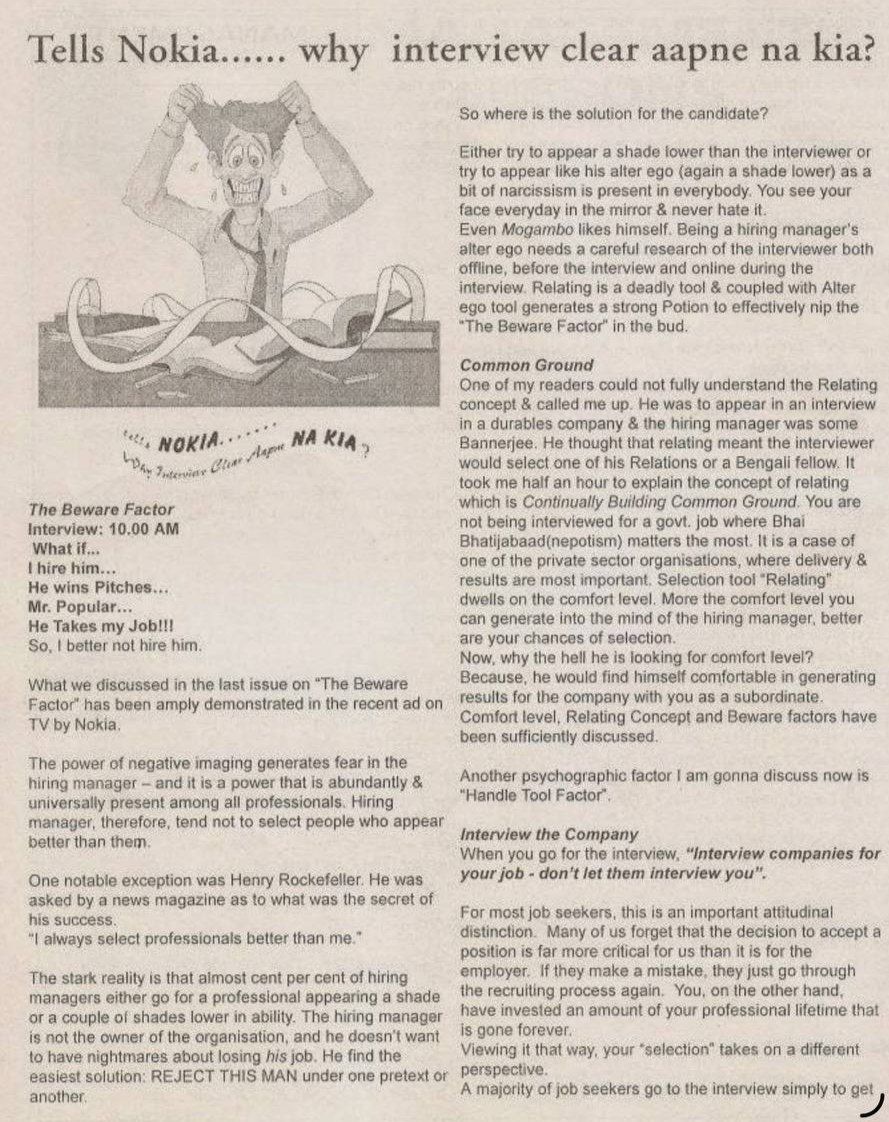
JOBNET March 2004 — Page 1
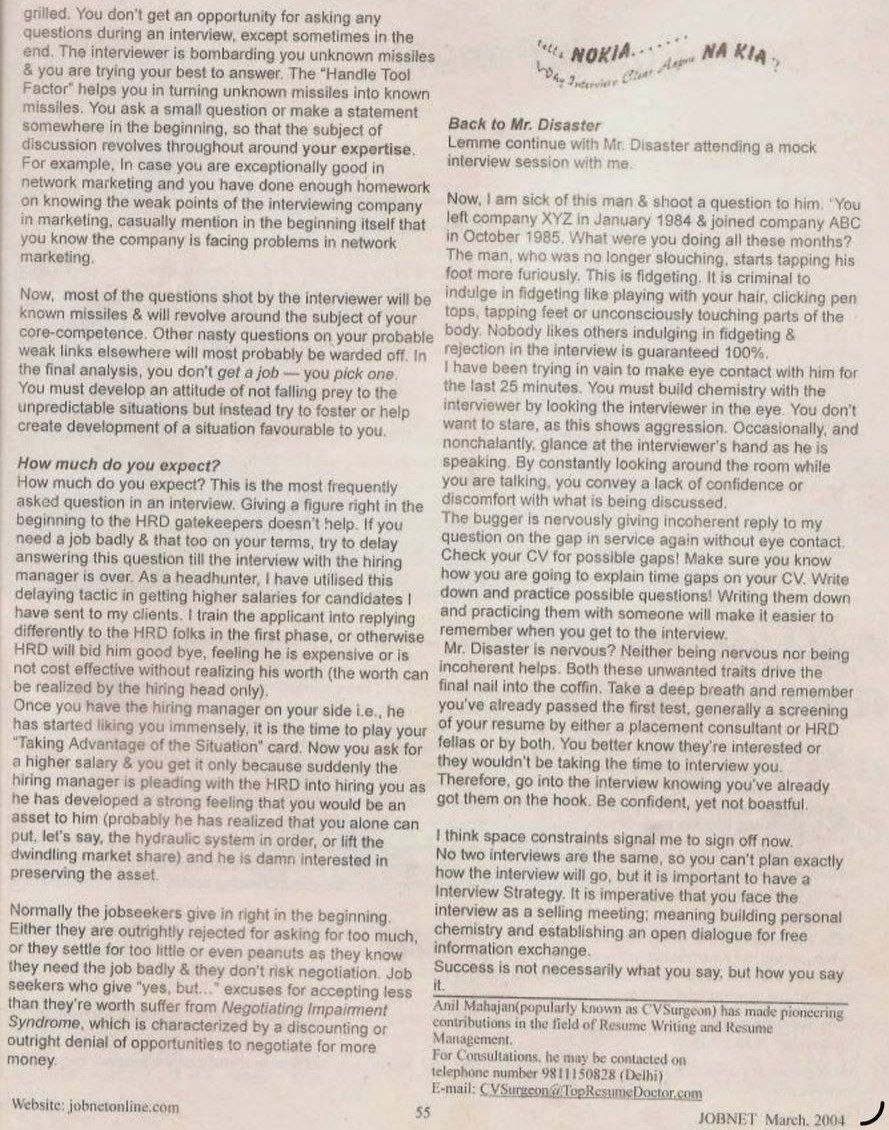
JOBNET March 2004 — Page 2
Article Transcript
Tells Nokia… Why Interview Aapne Clear Na Kia
Originally published in JOBNET — March 2004
The BEWARE Factor
What a Nokia Ad Revealed About Hiring
What we discussed in the last issue on "The Beware Factor" has been amply demonstrated in a recent TV ad by Nokia. The power of negative imaging generates fear in the hiring manager — a power abundantly and universally present among professionals.
Hiring managers therefore tend not to select people who appear better than them. One notable exception was Henry Rockefeller, who when asked the secret of his success said: "I always select professionals better than me."
The stark reality is that almost cent per cent of hiring managers go for a professional appearing a shade or a couple of shades lower in ability. The hiring manager is not the owner of the organisation, and he doesn't want to have nightmares about losing his job. He finds the easiest solution: REJECT THIS MAN under one pretext or another.
Three Interview Tools
The Psychographic Toolkit
01
The Alter Ego Tool
Appear like the interviewer's alter ego — a shade lower in perceived ability. Being a hiring manager's alter ego needs careful research of the interviewer both offline before the interview and online during the interview. Narcissism is present in everybody — you see your face everyday in the mirror and never hate it.
02
The Relating Tool
Continuously Build Common Ground. The more comfort level you can generate in the mind of the hiring manager, the better your chances of selection. He is looking for comfort because he would find himself comfortable generating results with you as a subordinate.
03
The Handle Tool
Turn unknown missiles into known missiles. Ask a small question or make a statement early on so that the subject of discussion revolves around your expertise. If you are exceptionally good in network marketing, mention the company's weak points in that area — most questions will then fall within your core competence.
You must develop an attitude of not falling prey to unpredictable situations but instead fostering development of a situation favourable to you. Interview companies for your job — don't let them interview you.
Salary Strategy
The Art of Salary Negotiation
"How much do you expect?" is the most frequently asked question in an interview. Giving a figure right at the beginning to HRD gatekeepers doesn't help. Try to delay answering this question until the interview with the hiring manager is over.
Mr. Disaster Continues
Three More Interview Mistakes
- Fidgeting. When asked about a gap in his employment, Mr. Disaster started tapping his foot furiously. It is criminal to indulge in fidgeting — playing with hair, clicking pen tops, tapping feet or touching parts of the body. Rejection in the interview is guaranteed 100%.
- No eye contact. You must build chemistry with the interviewer by looking him in the eye. Don't stare — that shows aggression. Occasionally glance at the interviewer's hand as he speaks. Constantly looking around the room conveys a lack of confidence or discomfort with what is being discussed.
- Unexplained CV gaps. Check your CV for possible gaps. Make sure you know exactly how you are going to explain time gaps. Write down and practise possible questions — doing so will make it easier to remember under pressure.
Take a deep breath and remember: you've already passed the first test — a screening of your resume by a placement consultant or HRD. They're interested or they wouldn't be taking time to interview you. Go into the interview knowing you've already got them on the hook. Be confident, yet not boastful.
No two interviews are the same, so you can't plan exactly how the interview will go — but it is important to have an Interview Strategy. Face the interview as a selling meeting: build personal chemistry and establish an open dialogue for free information exchange.
Success is not necessarily what you say,
but how you say it.
Then & Now
Why Excellent Candidates Still Miss Opportunities Today
Today's professionals may participate in AI-assisted screening, virtual interviews, leadership assessments, business case discussions and multiple rounds of executive interviews. Yet one reality has not changed — many highly capable candidates are still rejected not because they lack competence, but because they fail to communicate their value effectively.
Employers are no longer looking only for people who have performed a role. They are looking for professionals who can clearly demonstrate how they made a difference — across:
How the Concept Has Evolved
2004 → 2026
Then — 2004
- Interviews focused largely on qualifications
- Candidates often repeated information from their resumes
- Interview preparation centred on expected questions
- Communication skills were important but underestimated
Today — 2026
- Interviews evaluate leadership capability and business judgement
- Behavioural interviewing has become common practice
- Business storytelling demonstrates experience more effectively
- Executive presence and communication influence hiring decisions
- Organisations hire professionals who connect experience to challenges
- Relevance is often more persuasive than presenting more information
The Modern Process
The Modern Executive Interview Journey
At every stage, candidates are evaluated on their ability to communicate experience, demonstrate leadership and create confidence.
Executive Profile
AI / ATS Screening
Recruiter Discussion
Behavioural Interview
Business Case Discussion
Leadership Assessment
CXO / CEO Interview
Final Selection
Key Takeaways
What This Article Established
- Technical competence alone rarely secures leadership opportunities
- Communication transforms experience into credibility
- Business achievements should be supported by measurable outcomes
- Interviewers remember relevant examples more than lengthy explanations
- Preparation improves confidence and clarity
- Leadership interviews reward professionals who connect experience to organisational needs
Practical Advice
Before Attending an Interview, Ask Yourself
- Can I explain my biggest achievements in simple business language?
- Do I have examples that demonstrate leadership, problem-solving and decision-making?
- Have I researched the organisation's priorities and challenges?
- Can I connect my experience to the role I am seeking?
- Am I answering the interviewer's questions — or simply describing my career?
- Have I prepared thoughtful questions that demonstrate curiosity and business understanding?
Interviews are not about proving that you know everything. They are about helping the interviewer understand why you are the right person to solve their business challenges.
Looking Ahead
Capability Is Not Enough Without Communication
Artificial Intelligence will continue to change recruitment, but leadership hiring will always remain a human decision. The professionals who consistently succeed are those who combine expertise with clarity, confidence and authenticity.
That is the central lesson of Tells Nokia… Why Interview Clear Aapne Na Kia? — remarkably relevant more than two decades later.
About the Author
Anil Mahajane
MBA (IIFT) · Founder & Director, C-Suite Talent Management Consulting
30+ years of executive search and leadership advisory across India and the Middle East — spanning GCCs, Defence & Aerospace, Healthcare, Consumer Electronics, Steel, Cement and Infrastructure.
Continue Reading