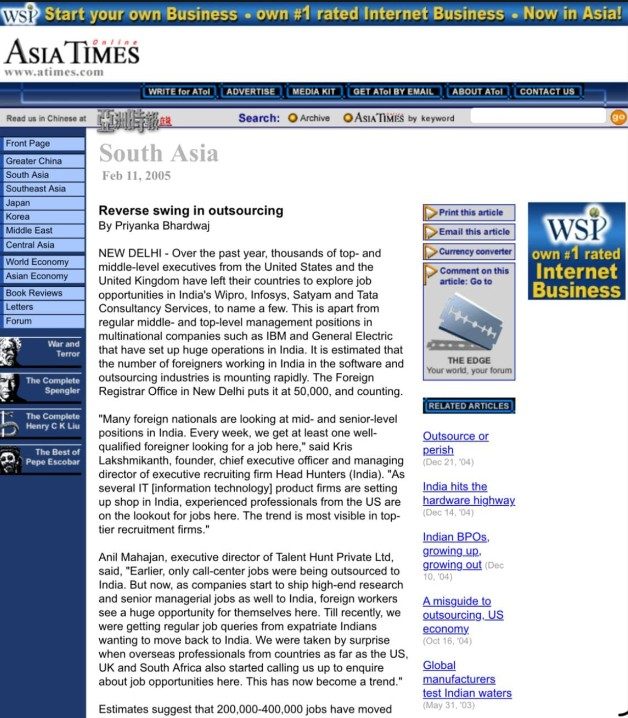
Asia Times Online, South Asia Edition, 11 February 2005 — "Reverse Swing in Outsourcing" · Interview with Anil Mahajane, Talent Hunt Private Limited
Publication Details
Beyond Cost Arbitrage — India's Second Outsourcing Story
By early 2005, outsourcing had become one of the defining political and economic issues in the United States and Europe. The public debate focused almost entirely on jobs leaving developed economies. This Asia Times feature captured a more complex and ultimately more significant reality: outsourcing was creating a reverse swing — drawing talent and investment back into India in ways that had not been anticipated.
The article documented how Indian technology giants were expanding globally and how foreign professionals were increasingly seeking employment in India as high-value work — research, engineering, senior management — moved eastward.
Observations from Anil Mahajane
Indian IT Goes Global — Creating Jobs in Both Directions
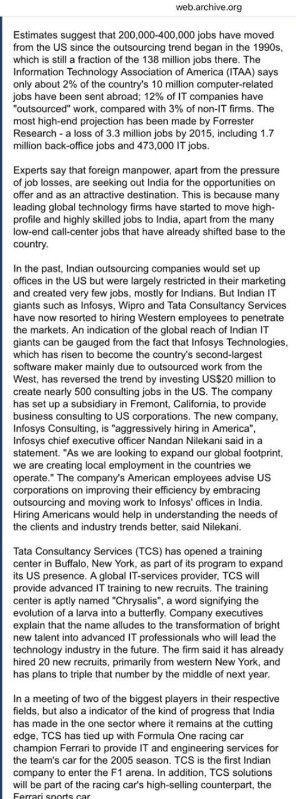
Infosys Technologies, India's second-largest software maker, reversed the outsourcing narrative by investing US$20 million to create nearly 500 consulting jobs in the United States. Its new subsidiary in Fremont, California — Infosys Consulting — was "aggressively hiring in America", with CEO Nandan Nilekani stating: "As we are looking to expand our global footprint, we are creating local employment in the countries we operate."
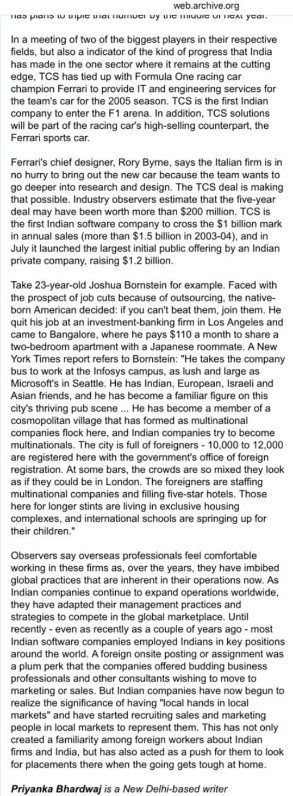
The article also noted a structural shift in how Indian IT companies approached Western markets. Previously restricted largely to Indian employees, firms such as Infosys, Wipro and TCS had begun hiring Western professionals to penetrate markets more effectively — a further sign that the talent dynamic between India and the West was becoming bidirectional.
From Back-Office to Knowledge Economy
The first wave of outsourcing to India was driven by cost: call centres, customer support, back-office processing. By 2005, a second wave was well underway — one defined by knowledge, innovation and leadership rather than cost alone:
- Research and Development centres established by global multinationals
- Product engineering and software development at scale
- Senior management and global delivery leadership roles
- Consulting and advisory functions
- Financial services and analytics operations
This transition fundamentally changed India's profile in the global economy — and made it an increasingly attractive destination for experienced international professionals, not just a source of cost savings.
The Trend That Defined India's Next Two Decades
When Anil Mahajane described a "reverse swing" in 2005, it was an observation at the frontier of a much larger transformation. The trajectory he described has since become one of India's defining economic characteristics.
India today hosts thousands of GCCs, major R&D centres and global innovation hubs. Indian technology companies are among the world's largest employers. The "reverse swing" has matured into a permanent, structural feature of the global economy — precisely as this interview anticipated.