JOBNET Career Intelligence
Yeh Resume Maange More - Part I
Your Resume Must Tell More Than Your Career History
About This Article
The Resume as a Marketing Document
In this thought-provoking article, Anil Mahajane challenged professionals to rethink the purpose of a resume. Rather than being a chronological record of education and employment, a resume should communicate professional value, achievements and future potential.
The article encouraged candidates to move beyond routine job descriptions and create resumes that clearly demonstrate their contribution, capabilities and career aspirations.
More than two decades later, this message is even more relevant in an increasingly competitive and technology-driven hiring environment. A resume is no longer just a document - it is often the first representation of a professional's leadership brand.
Original Publication
JOBNET - October 2003
Scanned pages from the original printed publication.
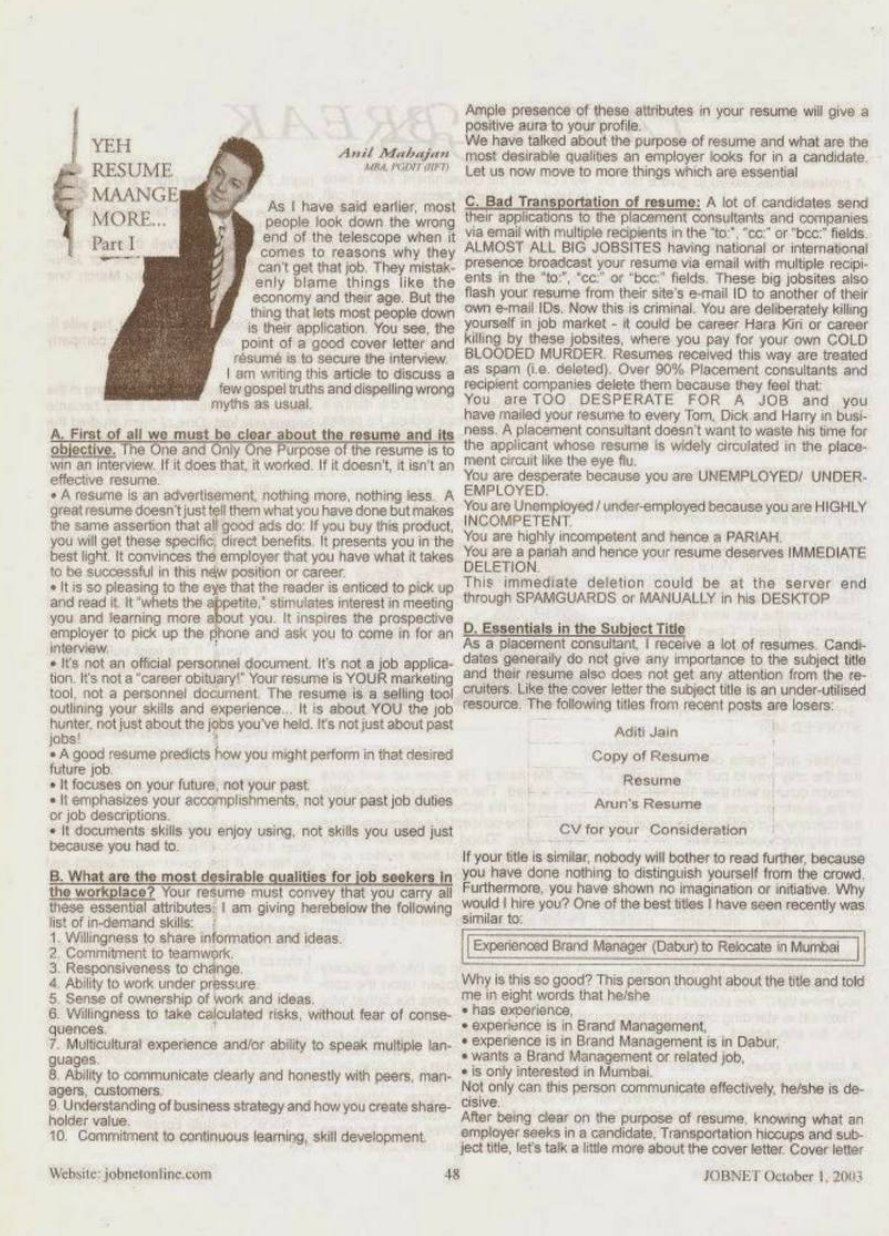
JOBNET October 2003 - Page 1
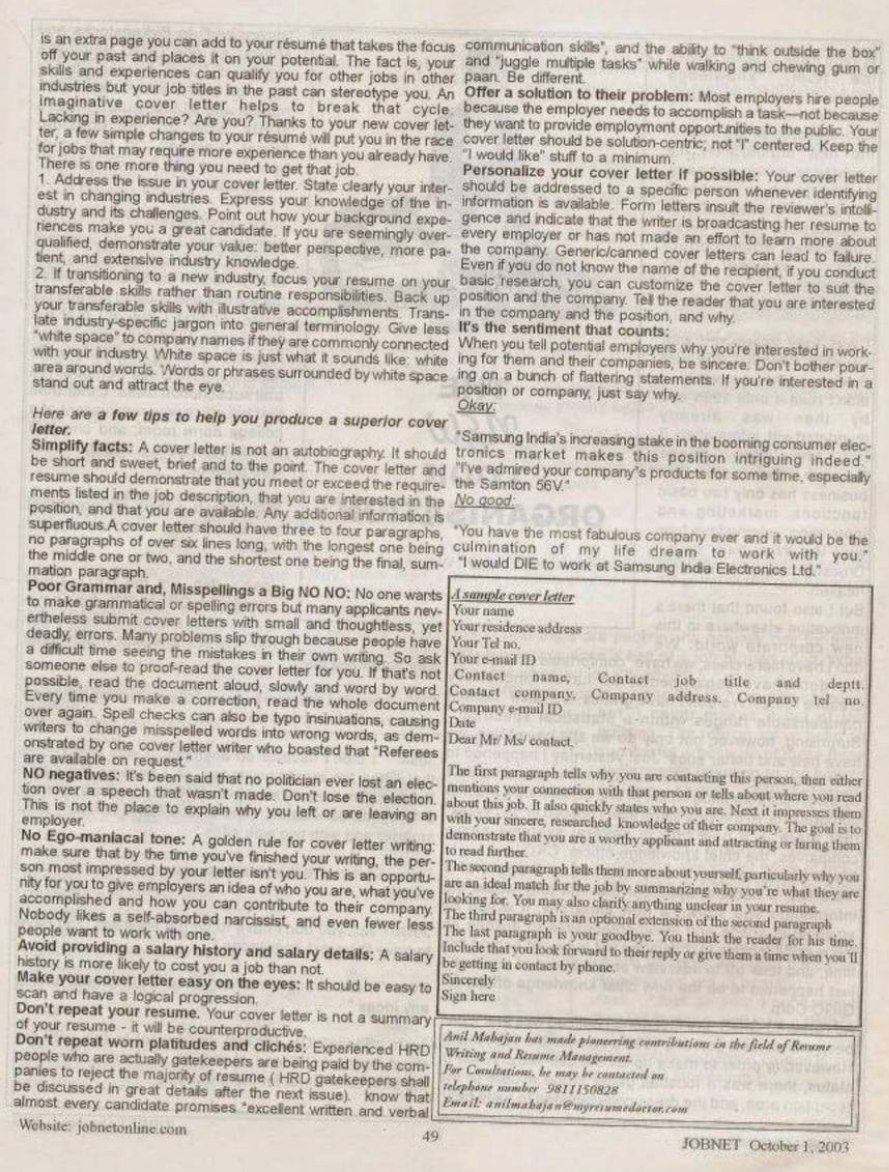
JOBNET October 2003 - Page 2
Article Transcript
Yeh Resume Maange More… Part I
Originally published in JOBNET - October 2003
As I have said earlier, most people look down the wrong end of the telescope when it comes to reasons why they can't get that job. They mistakenly blame things like the economy and their age. But the thing that lets most people down is their application. You see, the point of a good cover letter and résumé is to secure the interview. I am writing this article to discuss a few gospel truths and dispelling wrong myths as usual.
A
The Purpose of a Resume
First of all we must be clear about the resume and its objective. The One and Only One Purpose of the resume is to win an interview. If it does that, it worked. If it doesn't, it isn't an effective resume.
A great resume doesn't just tell them what you have done but makes the same assertion that all good ads do: If you buy this product, you will get these specific, direct benefits. It presents you in the best light. It convinces the employer that you have what it takes to be successful in this new position or career.
It is so pleasing to the eye that the reader is enticed to pick up and read it. It "whets the appetite," stimulates interest in meeting you and learning more about you. It inspires the prospective employer to pick up the phone and ask you to come in for an interview.
It's not an official personnel document. It's not a job application. It's not a "career obituary!" Your resume is YOUR marketing tool, not a personnel document. The resume is a selling tool outlining your skills and experience… It is about YOU the job hunter, not just about the jobs you've held. It's not just about past jobs!
- → A good resume predicts how you might perform in that desired future job
- → It focuses on your future, not your past
- → It emphasises your accomplishments, not your past job duties or job descriptions
- → It documents skills you enjoy using, not skills you used just because you had to
B
Most Desirable Qualities for Job Seekers
What are the most desirable qualities for job seekers in the workplace? Your resume must convey that you carry all these essential attributes:
- 1Willingness to share information and ideas
- 2Commitment to teamwork
- 3Responsiveness to change
- 4Ability to work under pressure
- 5Sense of ownership of work and ideas
- 6Willingness to take calculated risks, without fear of consequences
- 7Multicultural experience and/or ability to speak multiple languages
- 8Ability to communicate clearly and honestly with peers, managers, customers
- 9Understanding of business strategy and how you create shareholder value
- 10Commitment to continuous learning and skill development
Ample presence of these attributes in your resume will give a positive aura to your profile.
C
Bad Transportation of Resume
A lot of candidates send their applications to placement consultants and companies via email with multiple recipients in the "To:", "CC:" or "BCC:" fields. Almost all big job sites having national or international presence broadcast your resume via email with multiple recipients. These big job sites also flash your resume from their own email ID to another of their own email IDs. Now this is criminal.
Resumes received this way are treated as spam - deleted. Over 90% of placement consultants and recipient companies delete them because they feel you are TOO DESPERATE FOR A JOB and have mailed your resume to every Tom, Dick and Harry in business. The logic runs like a downward spiral: desperate → unemployed → incompetent → pariah → immediate deletion. This deletion could happen at the server level through spam guards or manually on the recruiter's desktop.
D
Essentials in the Subject Title
As a placement consultant, I receive a lot of resumes. Candidates generally do not give any importance to the subject title and their resume also does not get any attention from recruiters. Like the cover letter, the subject title is an under-utilised resource.
The following subject titles from recent posts are losers: Aditi Jain · Copy of Resume · Résumé · Arun's Resume · CV for your Consideration.
If your title is similar, nobody will bother to read further - you have done nothing to distinguish yourself from the crowd. One of the best titles I have seen recently was:
Effective Subject Title Example
Experienced Brand Manager (Dabur) to Relocate in Mumbai
- Has experience
- Experience is in Brand Management
- Brand Management experience is at Dabur
- Wants a Brand Management or related job
- Is only interested in Mumbai
Not only can this person communicate effectively - he/she is decisive. In eight words, the candidate told me everything I needed to know.
Cover Letter
Tips for a Superior Cover Letter
After being clear on the purpose of resume, knowing what an employer seeks in a candidate, transportation hiccups and subject title, let's talk a little more about the cover letter. Cover letter is an extra page you can add to your résumé that takes the focus off your past and places it on your potential.
If transitioning to a new industry, focus your resume on your transferable skills rather than routine responsibilities. Back up your transferable skills with illustrative accomplishments. Translate industry-specific jargon into general terminology.
- Simplify facts: A cover letter is not an autobiography. It should be short and sweet, brief and to the point. Three to four paragraphs, no paragraph over six lines long.
- No grammar or spelling errors: Even a small typo can look like a glaring error and may reflect on your ability to perform accurate work. Ask someone else to proof-read it for you.
- No negatives: This is not the place to explain why you left or are leaving an employer.
- No ego-maniacal tone: Make sure that by the time you have finished writing, the person most impressed by your letter isn't you.
- Avoid salary history: A salary history is more likely to cost you a job than not.
- Make it easy on the eyes: It should be easy to scan and have a logical progression.
- Don't repeat your resume: Your cover letter is not a summary of your resume - it will be counterproductive.
- Avoid clichés: Don't promise "excellent written and verbal communication skills" or the ability to "think outside the box." Be different.
- Offer a solution to their problem: Your cover letter should be solution-centric, not "I" centered.
- Personalise whenever possible: Address a specific person. Generic cover letters indicate the writer is broadcasting her resume to every employer.
- Be sincere: When you tell potential employers why you're interested in working for them, be genuine. Don't pour on flattering statements.
The right tone - a comparison:
Good
"Samsung India's increasing stake in the booming consumer electronics market makes this position intriguing indeed."
"I've admired your company's products for some time, especially the Samton 56V."
Not Good
"You have the most fabulous company ever and it would be the culmination of my life dream to work with you."
"I would DIE to work at Samsung India Electronics Ltd."
Sample
A Cover Letter Structure
Your name · Your residence address · Your Tel no. · Your email ID
Contact name, Contact job title and department
Contact company, Company address, Company tel no.
Company email ID · Date
Dear Mr / Ms / Contact,
The first paragraph tells why you are contacting this person, then either mentions your connection with that person or tells about where you read about this job. It also quickly states who you are. Next it impresses them with your sincere, researched knowledge of their company. The goal is to demonstrate that you are a worthy applicant and attract them to read further.
The second paragraph tells them more about yourself, particularly why you are an ideal match for the job by summarising why you're what they are looking for. You may also clarify anything unclear in your resume.
The third paragraph is an optional extension of the second paragraph.
The last paragraph is your goodbye. You thank the reader for his time. Include that you look forward to their reply or give them a time when you'll be getting in contact by phone.
Sincerely,
Sign here
Then & Now
Reimagining the Resume in Today's Talent Ecosystem
Since this article was first published in 2003, the role of the resume has changed dramatically. Recruiters no longer spend several minutes reading every application. Many resumes are first evaluated by Applicant Tracking Systems (ATS), AI-assisted recruitment tools and executive search databases before they reach a hiring manager.
Today's resume must satisfy two audiences:
- 1 Technology that identifies relevant experience and skills
- 2 Decision-makers who want evidence of leadership, business impact and future potential
A modern executive resume is expected to communicate:
The question has evolved from "What work have you done?" to "What value have you created?"
How the Concept Has Evolved
2003 → 2026
Then - 2003
- Resumes focused largely on qualifications and employment history
- Responsibilities received greater attention than achievements
- Most resumes were submitted in printed format
- Employers manually reviewed every application
Today - 2026
- Digital resumes are shared globally within seconds
- AI and ATS platforms perform the first level of screening
- Recruiters search LinkedIn and executive databases before interviews
- Organisations look for measurable business impact
- Leadership branding has become a competitive advantage
- Career storytelling differentiates exceptional professionals
Key Takeaways
What This Article Established
- Your resume should communicate business value, not merely experience
- Quantifiable achievements create stronger credibility than responsibilities
- Leadership potential should be visible throughout the document
- Every section should reinforce your professional brand
- A resume should answer why an organisation should invest in you
Practical Advice
Six Questions to Ask Before Updating Your Resume
- Does it demonstrate measurable business results?
- Are achievements supported by facts and outcomes?
- Does it highlight leadership rather than activity?
- Is your executive summary compelling?
- Does your profile reflect your future aspirations as well as your past experience?
- Would your resume stand out in both AI screening and executive review?
In today's hiring ecosystem, the most successful resumes are those that combine substance, clarity and strategic positioning.
Looking Ahead
One Principle That Has Not Changed
Technology will continue to reshape recruitment, but organisations will always seek leaders who can create measurable business value.
That was the core message of Yeh Resume Maange More - Part I in 2003, and it continues to define successful executive careers today.
About the Author
Anil Mahajane
MBA (IIFT) · Founder & Director, C-Suite Talent Management Consulting
30+ years of executive search and leadership advisory across India and the Middle East - spanning GCCs, Defence & Aerospace, Healthcare, Consumer Electronics, Steel, Cement and Infrastructure.
Continue Reading