JOBNET Career Intelligence
Death of the Bio-Data
When the Resume Began to Replace the Traditional Bio-data
About This Article
A Landmark Piece on Career Positioning
In this landmark article, Anil Mahajane questioned the traditional approach of treating a bio-data as merely a record of education and employment history.
The article explored how professionals need to present their experience, achievements and career value in a changing employment environment.
More than two decades later, these ideas have become even more relevant as organisations increasingly seek professionals who can demonstrate measurable business impact, leadership capability and strategic thinking.
Original Publication
JOBNET — August 2003
Scanned pages from the original printed publication.
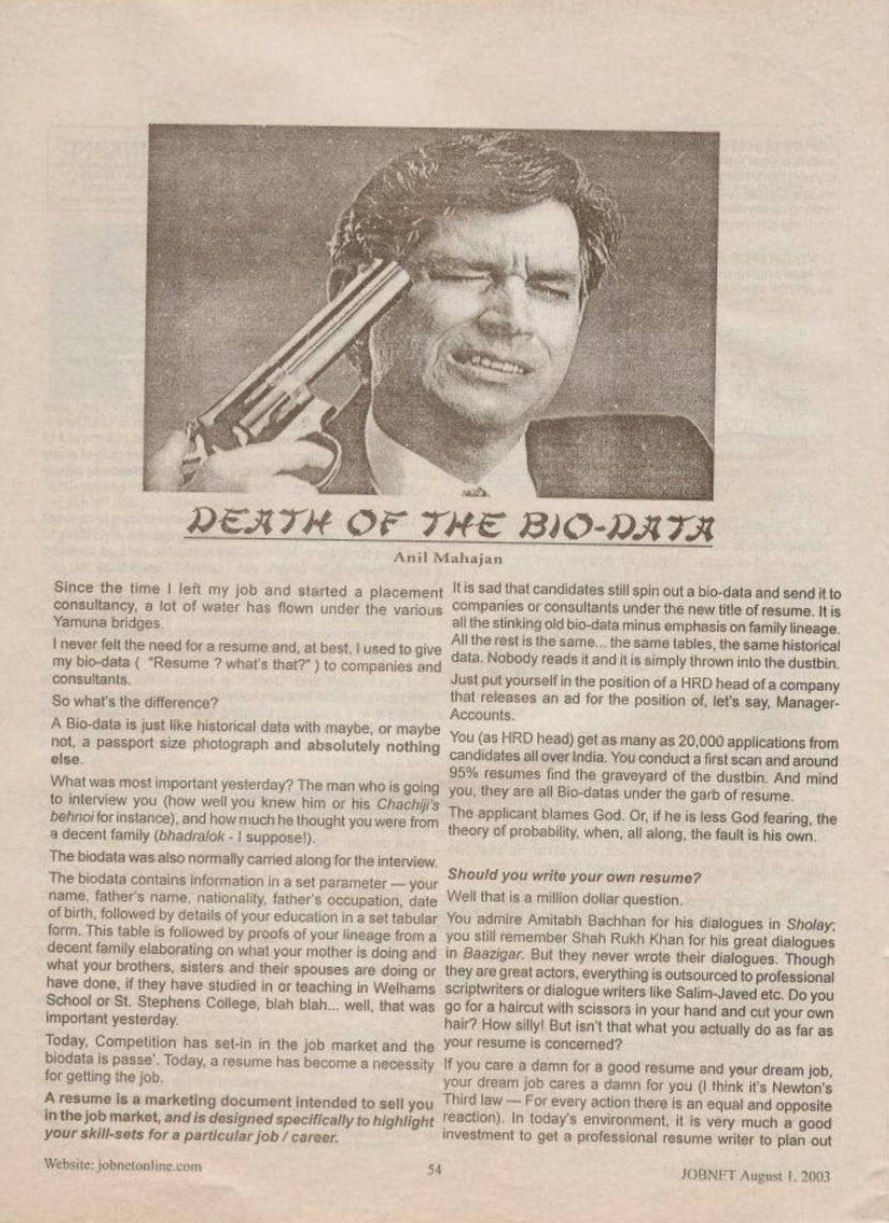
Page 54 — JOBNET August 2003
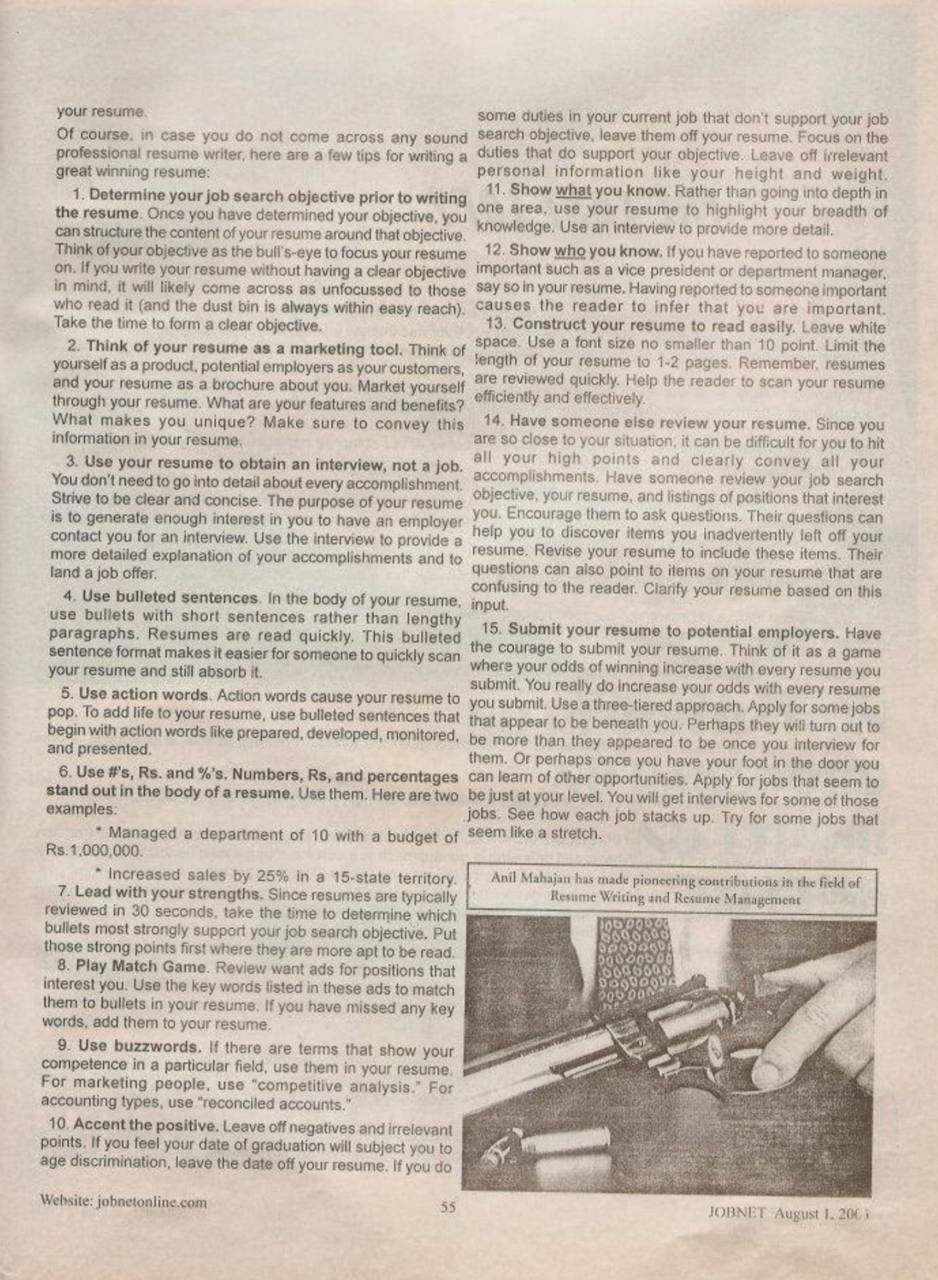
Page 55 — JOBNET August 2003
Article Transcript
Death of the Bio-Data
Originally published in JOBNET
Since the time I left my job and started a placement consultancy, a lot of water has flown under the various Yamuna bridges. I never felt the need for a resume and, at best, I used to give my bio-data ( "Resume? what's that?" ) to companies and consultants.
So what's the difference? A Bio-data is just like historical data with maybe, or maybe not, a passport size photograph and absolutely nothing else.
What was most important yesterday? The man who is going to interview you (how well you knew him or his Chachiji's behnoi for instance), and how much he thought you were from a decent family (bhadralok — I suppose!). The biodata was also normally carried along for the interview.
The biodata contains information in a set parameter — your name, father's name, nationality, father's occupation, date of birth, followed by details of your education in a set tabular form. This table is followed by proofs of your lineage from a decent family elaborating on what your mother is doing and what your brothers, sisters and their spouses are doing or have done, if they have studied in or teaching in Welhams School or St. Stephens College, blah blah… well, that was important yesterday.
Today, Competition has set-in in the job market and the biodata is passé. Today, a resume has become a necessity for getting the job.
It is sad that candidates still spin out a bio-data and send it to companies or consultants under the new title of resume. It is all the stinking old bio-data minus emphasis on family lineage. All the rest is the same… the same tables, the same historical data. Nobody reads it and it is simply thrown into the dustbin.
Just put yourself in the position of a HRD head of a company that releases an ad for the position of, let's say, Manager-Accounts. You (as HRD head) get as many as 20,000 applications from candidates all over India. You conduct a first scan and around 95% resumes find the graveyard of the dustbin. And mind you, they are all Bio-datas under the garb of resume. The applicant blames God. Or, if he is less God fearing, the theory of probability, when, all along, the fault is his own.
Should you write your own resume?
Well that is a million dollar question. You admire Amitabh Bachhan for his dialogues in Sholay; you still remember Shah Rukh Khan for his great dialogues in Baazigar. But they never wrote their dialogues. Though they are great actors, everything is outsourced to professional scriptwriters or dialogue writers like Salim-Javed etc. Do you go for a haircut with scissors in your hand and cut your own hair? How silly! But isn't that what you actually do as far as your resume is concerned?
If you care a damn for a good resume and your dream job, your dream job cares a damn for you (I think it's Newton's Third law — For every action there is an equal and opposite reaction). In today's environment, it is very much a good investment to get a professional resume writer to plan out your resume.
Of course, in case you do not come across any sound professional resume writer, here are a few tips for writing a great winning resume:
- 1 Determine your job search objective prior to writing the resume. Once you have determined your objective, you can structure the content of your resume around that objective. Think of your objective as the bull's-eye to focus your resume on. If you write your resume without having a clear objective in mind, it will likely come across as unfocussed to those who read it (and the dust bin is always within easy reach). Take the time to form a clear objective.
- 2 Think of your resume as a marketing tool. Think of yourself as a product, potential employers as your customers, and your resume as a brochure about you. Market yourself through your resume. What are your features and benefits? What makes you unique? Make sure to convey this information in your resume.
- 3 Use your resume to obtain an interview, not a job. You don't need to go into detail about every accomplishment. Strive to be clear and concise. The purpose of your resume is to generate enough interest in you to have an employer contact you for an interview. Use the interview to provide a more detailed explanation of your accomplishments and to land a job offer.
- 4 Use bulleted sentences. In the body of your resume, use bullets with short sentences rather than lengthy paragraphs. Resumes are read quickly. This bulleted sentence format makes it easier for someone to quickly scan your resume and still absorb it.
- 5 Use action words. Action words cause your resume to pop. To add life to your resume, use bulleted sentences that begin with action words like prepared, developed, monitored, and presented.
- 6 Use #'s, Rs. and %'s. Numbers, Rs, and percentages stand out in the body of a resume. Use them. Here are two examples: Managed a department of 10 with a budget of Rs.1,000,000. Increased sales by 25% in a 15-state territory.
- 7 Lead with your strengths. Since resumes are typically reviewed in 30 seconds, take the time to determine which bullets most strongly support your job search objective. Put those strong points first where they are more apt to be read.
- 8 Play Match Game. Review want ads for positions that interest you. Use the key words listed in these ads to match them to bullets in your resume. If you have missed any key words, add them to your resume.
- 9 Use buzzwords. If there are terms that show your competence in a particular field, use them in your resume. For marketing people, use "competitive analysis." For accounting types, use "reconciled accounts."
- 10 Accent the positive. Leave off negatives and irrelevant points. If you feel your date of graduation will subject you to age discrimination, leave the date off your resume. If you do some duties in your current job that don't support your job search objective, leave them off your resume. Focus on the duties that do support your objective. Leave off irrelevant personal information like your height and weight.
- 11 Show what you know. Rather than going into depth in one area, use your resume to highlight your breadth of knowledge. Use an interview to provide more detail.
- 12 Show who you know. If you have reported to someone important such as a vice president or department manager, say so in your resume. Having reported to someone important causes the reader to infer that you are important.
- 13 Construct your resume to read easily. Leave white space. Use a font size no smaller than 10 point. Limit the length of your resume to 1-2 pages. Remember, resumes are reviewed quickly. Help the reader to scan your resume efficiently and effectively.
- 14 Have someone else review your resume. Since you are so close to your situation, it can be difficult for you to hit all your high points and clearly convey all your accomplishments. Have someone review your job search objective, your resume, and listings of positions that interest you. Encourage them to ask questions. Their questions can help you to discover items you inadvertently left off your resume. Revise your resume to include these items. Their questions can also point to items on your resume that are confusing to the reader. Clarify your resume based on this input.
- 15 Submit your resume to potential employers. Have the courage to submit your resume. Think of it as a game where your odds of winning increase with every resume you submit. You really do increase your odds with every resume you submit. Use a three-tiered approach. Apply for some jobs that appear to be beneath you. Perhaps they will turn out to be more than they appeared to be once you interview for them. Or perhaps once you have your foot in the door you can learn of other opportunities. Apply for jobs that seem to be just at your level. You will get interviews for some of those jobs. See how each job stacks up. Try for some jobs that seem like a stretch.
Then & Now
Death of the Bio-Data in Today's Talent Landscape
The employment market has undergone a dramatic transformation since this article was first published. Traditional bio-data has largely disappeared, giving way to professional resumes, executive profiles, LinkedIn portfolios and AI-searchable digital identities.
Today's hiring decisions are influenced not only by qualifications but also by leadership capability, measurable achievements and business impact. Organisations increasingly evaluate candidates on their ability to create value, lead transformation and adapt to rapidly changing business environments.
The central message of Death of the Bio-data remains remarkably relevant: career documents should communicate contribution rather than merely record employment history.
How the Concept Has Evolved
2003 → 2026
Then — 2003
- Bio-data focused on personal information
- Job descriptions dominated resumes
- Career progression measured largely by experience
- Hiring relied primarily on manual screening
Today — 2026
- Executive resumes focus on measurable achievements
- LinkedIn profiles complement traditional resumes
- AI-assisted recruitment analyses keywords, skills and experience
- Executive search firms evaluate leadership capability and cultural fit
- Personal branding has become an essential career competency
Key Takeaways
What This Article Established
- A resume is far more than a list of qualifications
- Career documents should demonstrate measurable achievements
- Leadership potential should be visible through business outcomes
- Professional positioning influences hiring decisions
- Personal branding has become an essential leadership competency
Practical Advice
Five Questions Your Profile Must Answer
Whether you are an early-career professional or an experienced executive, your profile should answer these fundamental questions — increasingly important as recruiters and AI-driven platforms assess thousands of profiles every day.
Looking Ahead
One Principle That Has Not Changed
While technologies continue to evolve, one principle remains unchanged:
That principle formed the foundation of this article in 2003 and continues to guide successful executive careers today.
About the Author
Anil Mahajane
MBA (IIFT) · Founder & Director, CSuite Talent Management Consulting
30+ years of executive search and leadership advisory across India and the Middle East — spanning GCCs, Defence & Aerospace, Healthcare, Consumer Electronics, Steel, Cement and Infrastructure.
Continue Reading