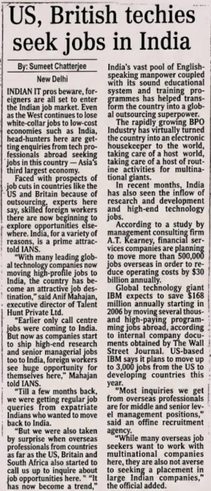
Original interview published in The Pioneer — 2004 — featuring Anil Mahajane discussing the growing trend of US and British technology professionals seeking employment opportunities in India.
Publication Details
Anil Mahajane in His Own Words
"With many leading global technology companies now moving high-profile jobs to India, the country has become an attractive job destination."
Anil Mahajane, Executive Director — Talent Hunt Private Ltd., quoted in The Pioneer"Earlier only call centre jobs were coming to India. But now as companies start to ship high-end research and senior managerial jobs too to India, foreign workers see huge opportunity for themselves here."
Anil Mahajane — The Pioneer, 2004"Till a few months back, we were getting regular job queries from expatriate Indians who wanted to move back to India. But we were also taken by surprise when overseas professionals from countries as far as the US, Britain and South Africa also started to call us up to inquire about job opportunities here. It has now become a trend."
Anil Mahajane — The Pioneer, 2004When India Began Attracting Global Technology Talent
During the early 2000s, India was primarily recognised as a destination for outsourcing and offshore technology services. However, beneath this rapidly growing industry, another significant trend was beginning to emerge.
Experienced technology professionals from the United States and the United Kingdom were increasingly exploring career opportunities in India. Attractive leadership positions, multinational investments, expanding technology companies and globally competitive work environments were transforming India into a destination for international talent.
In this exclusive interview with The Pioneer, Anil Mahajane analysed this emerging phenomenon and explained why India was no longer merely exporting skilled professionals — it was beginning to attract them. The interview anticipated a structural shift in global talent mobility that would become increasingly evident over the following decades.
India's Emergence as a Global Technology Hub
The early years of the twenty-first century represented a turning point for India's technology and knowledge economy. International corporations established major development centres across Bengaluru, Hyderabad, Pune, Chennai, Delhi NCR and other technology hubs. Simultaneously, Indian enterprises expanded globally, creating demand for experienced professionals capable of leading multicultural and geographically distributed teams.
For decades, India's brightest engineers and technology specialists had migrated overseas in pursuit of career opportunities. This interview documented the beginning of a reversal, as international professionals increasingly recognised India's dynamic business environment, growing innovation ecosystem and expanding leadership opportunities.
Today, India is home to one of the world's largest technology workforces, thousands of Global Capability Centres (GCCs), world-class engineering organisations, research centres, AI laboratories and multinational innovation hubs. The developments discussed in this interview proved to be an early indicator of this transformation.
What Anil Mahajane Observed
A Landmark Record of India's Transition
When this interview was published, discussions surrounding India's technology industry focused largely on outsourcing and the migration of Indian professionals to Western economies. Anil Mahajane presented a different perspective — that India was becoming attractive not only for investment but also for international careers.
He anticipated that highly qualified professionals from developed economies would increasingly view India as a destination for leadership opportunities, innovation and long-term professional growth.
Over the following years, this prediction became reality. India emerged as one of the world's largest destinations for GCCs, multinational R&D facilities, engineering centres, digital transformation initiatives and global leadership roles. Today, international executives routinely relocate to India while Indian leaders continue to shape businesses across the world. This interview stands as an early record of that transformational shift.